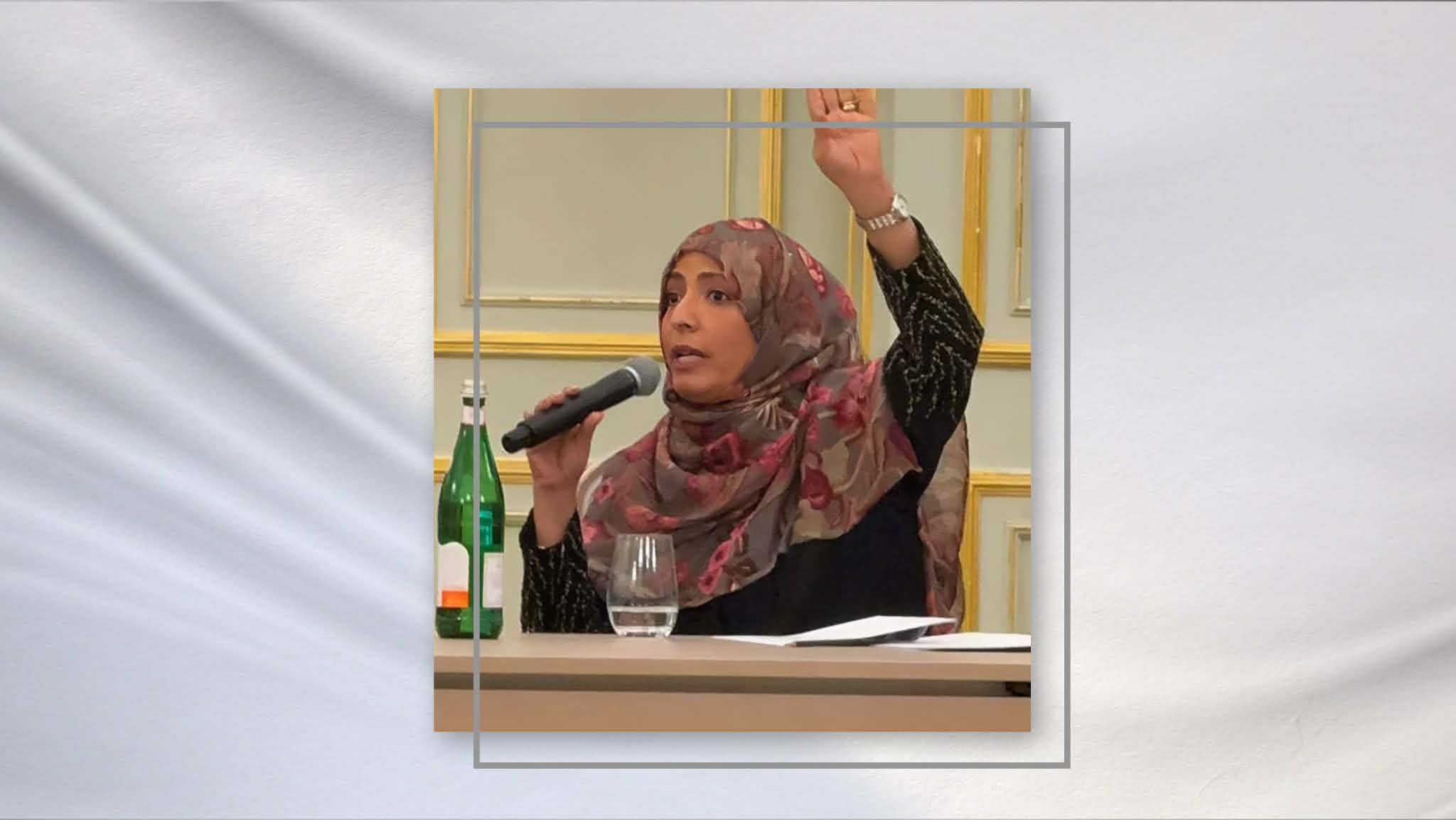
Mrs. Tawakkol Karman's Address at the World Forum on Democracy, AI/Tech and Humankind – Berlin
We meet today within the framework of the Women’s Progress Dialogue—an initiative that does not simply measure the condition of women in our world, but seeks to change it. This initiative begins from a truth that we must never compromise: the advancement of women is not a marginal issue, not a secondary reform, and not a domestic concern confined within borders. It is the true measure of justice, the real test of freedom, and the clearest expression of human dignity.
Today we examine indicators that rank nations according to their commitment to women’s rights. Before us stand three realities. There are nations moving forward, striving sincerely toward equality. There are nations retreating, hesitating, and delaying reform. And there are nations that continue to practice discrimination and systematic violations against women.
I hope this index serves as a source of encouragement for advanced nations, a form of pressure on hesitant and regressive ones, and a mechanism of accountability for those that violate women’s rights.
What struck me in this report is its classification of the United Kingdom among advanced nations. This raises a fundamental question: Can a state claim commitment to women’s rights if it protects them domestically while supporting regimes abroad that violate human rights and suppress women’s freedoms?
This standard is flawed and requires reform. A state that supports tyranny, occupation, coups, or repression abroad cannot claim full commitment to women’s rights, regardless of its domestic progress. Women’s rights are indivisible; they cannot be protected at home while being undermined elsewhere.
In this context, I wish to underscore that the struggle for women’s rights transcends the pursuit of token representation within authoritarian or pseudo-democratic structures. It is far more than a quest for empowerment programs alone. At its core, it is a struggle for liberty—for the advancement of democracy, for sustainable development, and for the unwavering observance of the rule of law.
It is a battle for her right to genuine and full political participation, for education, for health, for economic empowerment, and for equality in all aspects of life.
This entire struggle can be distilled into a single word: freedom. And it begins with one central imperative: resisting tyranny—both domestic and global.
This was, and remains, our sacred struggle—we, the women of the Arab Spring. For us, the overthrow of tyranny has been the most effective path to victory for human rights and for women’s rights.
I recall 2011, when a UN official visited Yemen to discuss ways of advancing women’s rights. I told her plainly: the primary battle for Yemeni women is not token representation to decorate a failed regime, but resistance to despotism itself—the system that denied education, deepened poverty, excluded women, and dragged the nation into war. Despotism is their foremost enemy, the root from which all injustice spreads.
Today, we face a dangerous moment in history. Authoritarianism is expanding across the world. A new global tyranny is emerging—one that seeks to erase humanity’s greatest achievements, including the progress women have fought for across generations. It seeks to dismantle international law and replace it with the rule of power. It seeks to replace cooperation with domination, and justice with force.
This system suffers from flaws and shortcomings. For decades it has been plagued by double standards, biased toward powerful nations at the expense of justice, and unable to prevent tyranny and occupation from devastating countries and committing crimes against humanity.
That is why we have always called—and continue to call—for reform, not dismantling. We demand a reformed United Nations with binding resolutions, a reformed Security Council without veto monopolies, and a more just world order—one that champions humanity, rejects oppression, ensures genuine representation for the Global South, and advances social justice and equality worldwide.
This flaw has emboldened despots worldwide, fueling their appetite for destruction, expansion, human rights violations, the theft of popular revolutions, and even the revival of imperial logic that predates the rules-based order.
We must not allow this to happen, and we must unite to confront it. Yet today, this systematic assault on the international order is met with acquiescence—even adaptation—by some democracies, while authoritarian regimes celebrate.
We must stand together, as a global feminist movement and as democrats, against expanding despotism, which has grown stronger since the leadership of this camp shifted from Putin’s Russia to Trump’s America.
This is the gravest threat to humanity, human rights, women’s rights, the environment, the economy, and global peace—especially when the world’s most powerful nation is led by a corrupt, despotic, fascist president.
I am a woman who lived under tyranny, rebelled against it, and helped bring it down. I continue, with courageous leaders across the Arab world, to lead the struggle for freedom, justice, democracy, and peace—confronting counter-revolutions, coups, militias, wars, terrorism, occupation, and the despots who sustain them.
I know tyranny: how it begins, what it feeds on, how it infiltrates power, entrenches itself, and destroys nations, societies, and individuals.
What is happening in America and other democracies—the spread of hatred, racism, division, and polarization—are tools tyrants use to seize and consolidate power. They begin by silencing expression, branding the media an enemy, eroding the rule of law, undermining judicial independence, stripping legislatures of authority, and weakening institutions until they serve only the ruler, his family, and his loyalists.
Donald Trump today stands as a foremost supporter of autocrats and a source of inspiration for fascism. The decline of democracy in democratic nations threatens not only their people but the entire world. When democracy weakens at its center, autocracy strengthens at the margins, and when the world loses its democratic model, hope itself is extinguished.
Women’s rights cannot be safeguarded in a world led by autocrats, nor defended in a system that tolerates oppression, nor achieved without protecting democracy itself. Our struggle, as women, is therefore a struggle to defend freedom, the rule of law, and democracy.
It is vital to support the struggle of the American people—and American women in particular—to protect their democracy and institutions.
We stand with you in your struggle against Donald Trump, affirming that your democracy requires genuine reform—reform that strengthens accountability and prevents thugs, corrupt figures, and abusers from seizing power and hijacking it through the very instruments of democracy. Such reform must correct past mistakes, end policies that empower despots and devastate nations, and restore to democracy its moral meaning and human responsibility.
This is the defining struggle of our time. It is the struggle that will determine the future of women’s rights. It is the struggle that will determine whether humanity moves toward justice or toward domination.
The fight for democracy is the fight for women’s freedom.
The fight for justice is the fight for human dignity.
And the fight for freedom is the fight for the future itself.
Your struggle is our struggle.
Your battle is our battle.
Your freedom is our freedom.
Thank You!