
Wjwc News
Arbitrary Arrests and Human Rights Violations in Taiz Governorate Raise Concerns
Recent developments in Taiz Governorate have drawn serious concern over violations of fundamental rights, particularly the freedoms of expression and press, as well as the protection of journalists and human rights activists. Since the beginning of January 2026, security forces affiliated with the Taiz Police have reportedly taken arbitrary measures against a number of journalists, activists, and media professionals, based on their publications and opinions, under the pretext of a declared state of emergency.
Taiz has long been recognized for a relatively wide margin of public freedoms and active civil and journalistic engagement, even amid complex security and political circumstances. The recent crackdown targeting journalists and activists represents a significant and unprecedented deviation from this tradition, raising alarm over the trajectory of human rights in the governorate.
Legal Context and Abuse of Authority
The declaration of a state of emergency by the head of the Presidential Leadership Council does not constitutionally suspend the Yemeni constitution or existing laws. Nor does it grant security agencies absolute powers, especially in the absence of emergency legislation issued by the legislative authority to define the scope and regulation of such measures. Security agencies are legally bound to operate within the framework of Yemeni law, including criminal codes and procedures, and any deviation constitutes a clear violation of the rule of law.
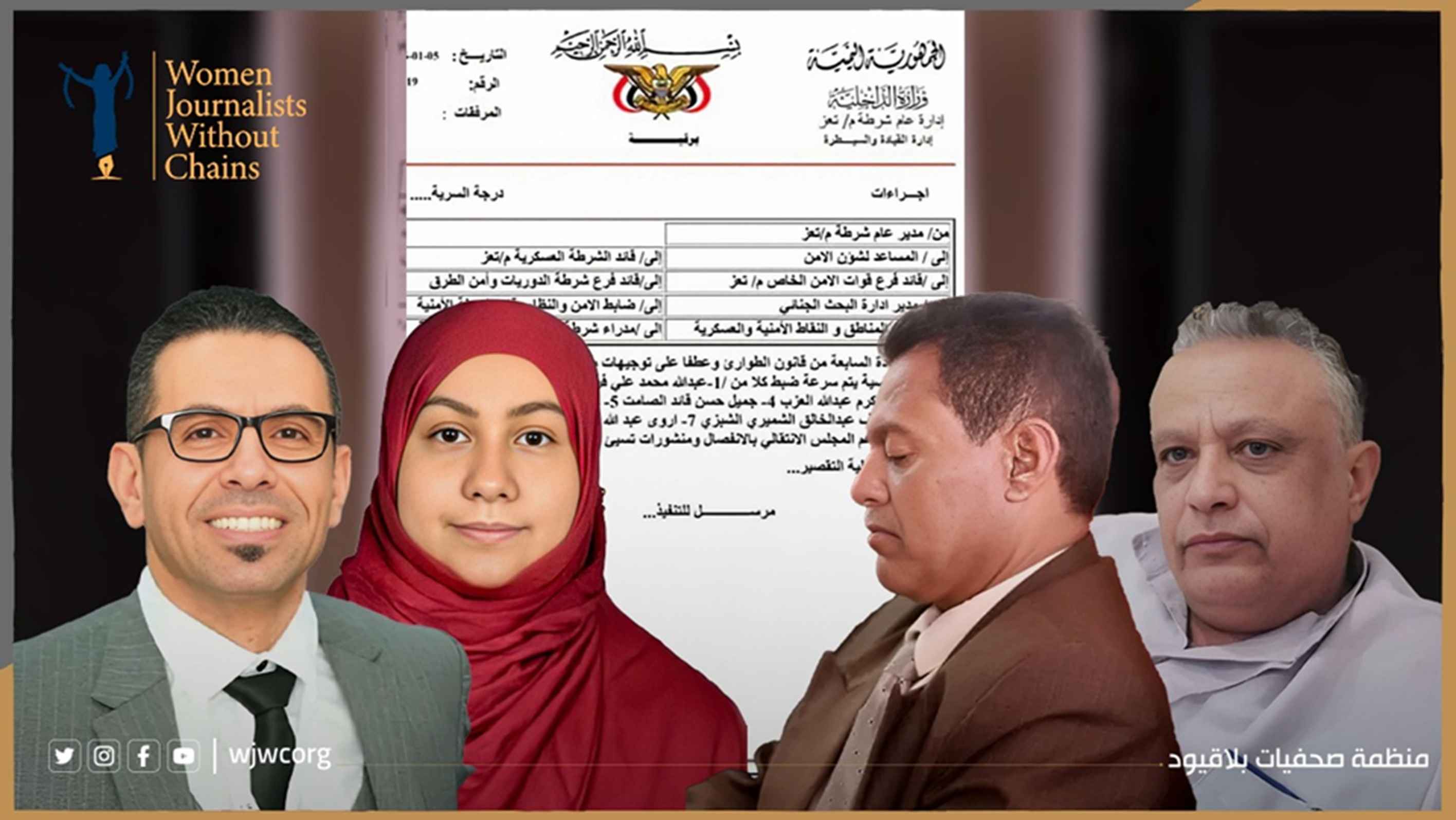
Reports indicate that the Taiz Governorate Police issued a directive on January 5, 2026, instructing the arrest of several journalists and activists based on their opinions and publications. The directive cited a so-called “Article Seven of the Emergency Law,” a non-existent legal provision. Such actions are seen as a serious overreach of authority, usurping the powers of the Public Prosecutor and undermining the principle of separation of powers.
Documented Incidents of Arbitrary Detention
On January 4, 2026, media activist Abdullah Farhan was forcibly removed from a private gathering by armed men, physically assaulted in front of witnesses, and taken to an unknown location without an arrest warrant or explanation. This constitutes arbitrary detention and use of force outside the legal framework.
Security forces also raided the home of activist Arwa al-Shumairi without a warrant, official summons, or the presence of female police officers. Her son was detained and coerced into signing a pledge on her behalf, in violation of the principle of individual responsibility and children’s rights. Al-Shumairi herself was briefly detained before being released, underscoring the arbitrary nature of the measures.
Repeated attempts were made to raid the home and offices of Abdulkhaliq Saif, former director of the Culture Office in Taiz, for the purpose of arresting him without legal justification. Political and human rights activist Abubakr al-Asbahi was detained in al-Turbah for several hours due to critical posts and his representation of human rights victims, illustrating a broader pattern of criminalizing freedom of expression and peaceful activism.
Threats to Due Process and Public Safety
The leaking of a classified security cable containing the names of citizens and unproven accusations has been identified as official defamation and public incitement, endangering those targeted and undermining social stability. Such practices violate the most basic standards of justice and the rule of law.
Authorities released several targeted individuals, including Abdullah Farhan, Jamil al-Samet, Jamil al-Shujaa, and Arwa al-Shumairi, and ceased pursuing others, following presidential directives. However, release alone is insufficient to address the systemic issues. There is a need for a thorough, independent investigation into the violations, accountability for those responsible, and assurances that such abuses are not repeated.
Calls for Legal Compliance and Protection of Freedoms
Security forces are urged to operate strictly within the legal framework under the supervision of the Public Prosecutor’s Office, ceasing all practices targeting journalists and activists for their opinions or peaceful activities. The protection of public freedoms and freedom of the press remains a fundamental pillar of any state committed to the rule of law.
Safeguarding civil society in Taiz requires correcting these deviations and preventing them from becoming permanent practices that threaten the rights and freedoms of citizens. Upholding freedom of expression and protecting journalists is recognized as a national responsibility that cannot be compromised.
Released by:
Women journalists Without Chains
January 14, 2026