
Activities
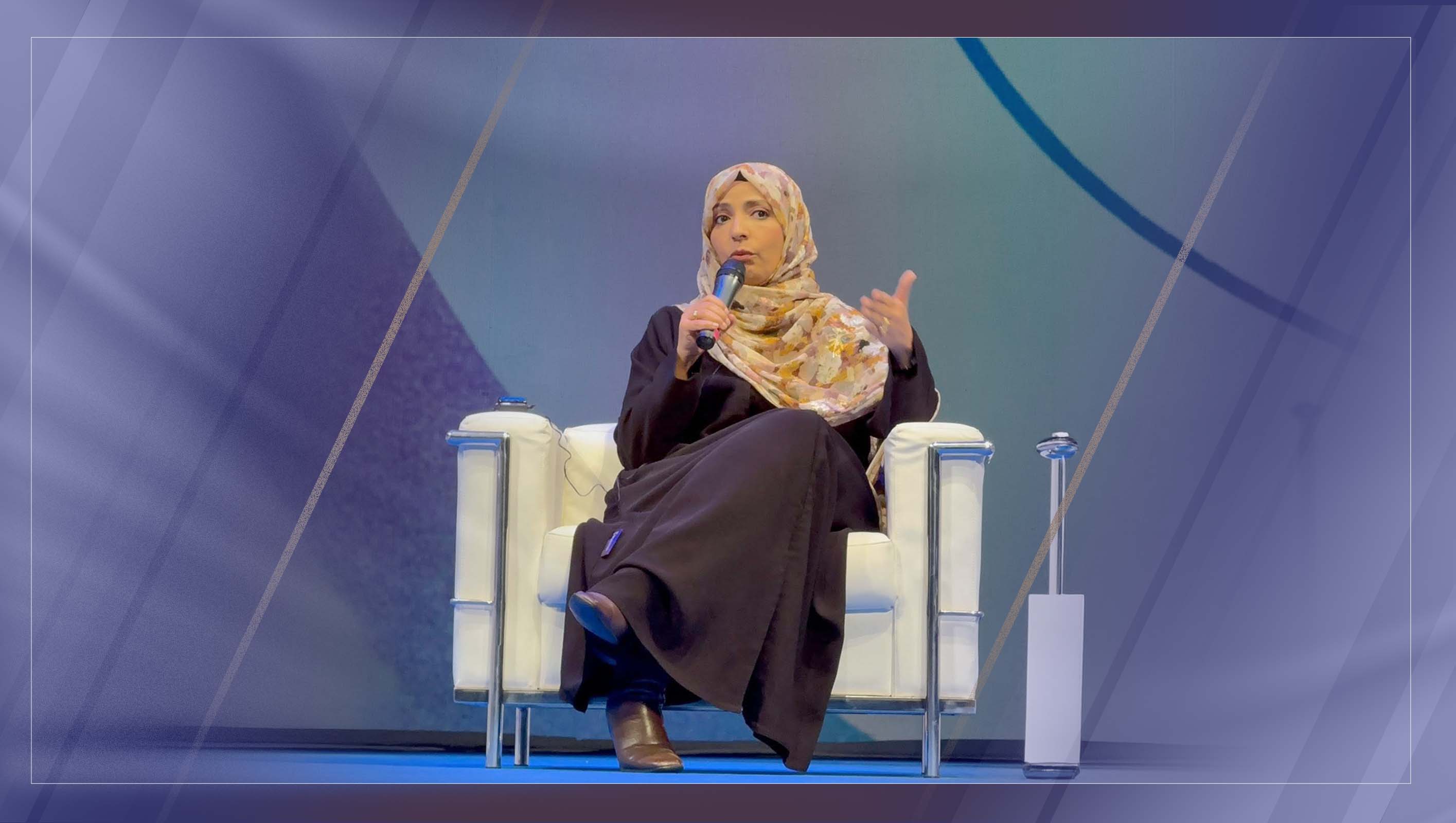
Karman Warns of Global Order's Collapse, Urges New Leadership for Justice and Human Rights
ZARAGOZA, Spain — At the Ibercaja Foundation’s 150th anniversary conference, human rights advocate and Nobel Peace Prize laureate Tawakkol Karman warned that the international system is collapsing, urging a new generation of leaders to confront authoritarianism, inequality, and indifference.
Speaking during “The World To Come” forum on June 18–19, Karman addressed activists, policymakers, and civil society leaders, tracing the world’s democratic deterioration directly to governments’ abandonment of sustainable development and human rights commitments.
"How your communities, your countries, are really under threat from the deterioration in democracy—and this deterioration in democracy that you face—and the rise of hatred, the rise of racism," she said. "This is a result of the lack of commitment from your leaders."
Karman pointed to former U.S. President Donald Trump's stated intention to invade Greenland as a stark illustration of the breakdown. "All Europe screamed because of it," she remarked. "What are you doing, Mr. Trump?" For Karman, the incident was not an isolated provocation but evidence of a broader collapse—one she said the world has already witnessed in Arab countries under Israeli occupation and in dictatorial regimes that kill their own people while the international community stands idle.
"The democratic countries now have to gather themselves to save the global order," she said, "to reform the global order from double standards."
Throughout her intervention, Karman returned to a central theme: globalization has become an engine of inequality that enriches wealthy nations while marginalizing the poor, not only economically but in terms of democracy and environmental protection. She warned that without immediate reform, authoritarian powers will continue to consolidate, "hijack everything," and ultimately threaten even established democracies.
"We shouldn't let Vladimir Putin, or Netanyahu, or Trump, or these super-rich companies destroy our climate, the economy, and peace itself," she said.
Karman was equally critical of international institutions. She called for sweeping United Nations reforms and the creation of "binding procedures" to force governments to honor their obligations on development, justice, peace, human rights, and the environment. The alternative, she cautioned, is a world where dictatorship camps grow increasingly coordinated and emboldened.
But she directed much of her energy toward the audience itself. With a directness that defined the session, she told attendees that the current generation of leaders has failed and that young people must step forward across every sector—politics, civil society, media, and business.
"You have to prepare yourself to be the leader," she said. "There are no good leaders in the world right now. We need new leaders that will free the world from this greed, from this madness."
Karman also turned her attention to the private sector, framing corporate social responsibility as a non-negotiable duty at a moment when governments are retreating from their obligations. She noted that the United States has withdrawn from 60 international institutions, including the Paris Climate Agreement and the Human Rights Council, and has slashed 5,500 development programs. As public aid dries up, she argued, companies must fill the void rather than simply extracting profits.
"If the government retreats, companies should be there," she said, praising the Ibercaja Foundation's century and a half of social commitment and urging businesses to increase support for education, health, and poverty alleviation.
Despite the grim portrait she sketched, Karman expressed genuine optimism, crediting the energy of young people and the principled stance of Spain. "Muchas gracias," she said, addressing Spanish institutions, civil society, media, and citizens directly. "You are the ones who break the fears of injustice around the world, especially in these days of genocide and wars."
Karman also used the occasion to reject what she called a sanitized conception of peace. Dismissing expectations that a Nobel laureate should speak slowly and avoid controversy, she defined peace instead as continuous struggle.
"Peace for me is continuing the fight for justice, continuing the fight against wars, against corruption, against oppression," she said. "Before, it was against one dictator in my country; now it is against dictators around the world. Together we are the nightmare of dictators. A world without dictatorship—this is peace."
She distilled her worldview into a single word: compassion. Not sentimentality, she clarified, but a recognition of shared humanity that compels action against racism, violence, corruption, and injustice across political, social, economic, environmental, and digital spheres.
"We have to help each other," she said. "We have to love each other."