
Wjwc News
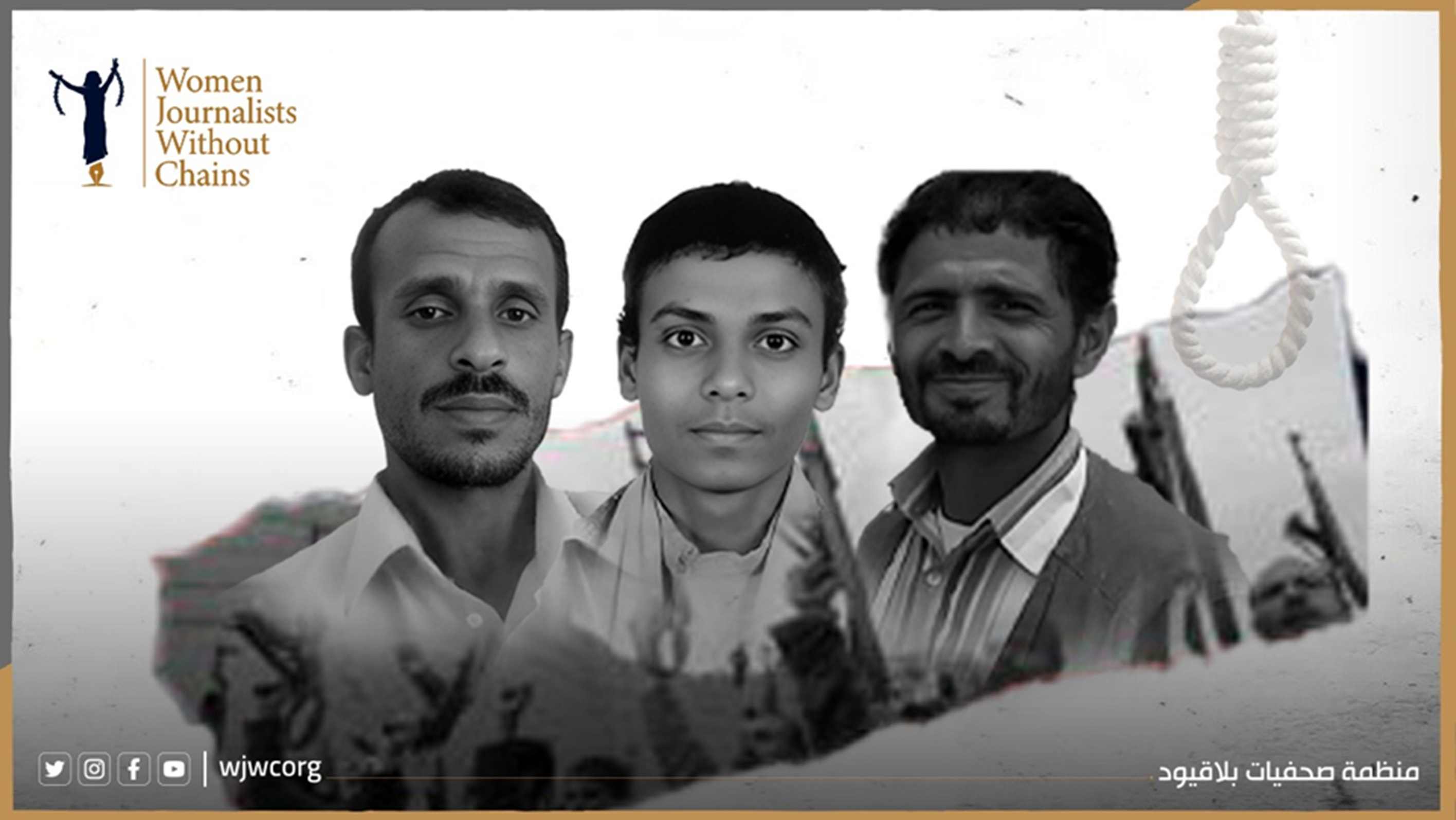
Extrajudicial Executions Loom as Illegitimate Courts Ratify Death Sentences in Sana’a
Grave and escalating concern surrounds the imminent threat to the lives of three civilian detainees following the ratification, on 17 December 2025, by the so-called Supreme Court operating under the control of the Houthi militia in Sana’a, of death sentences issued against them, and the subsequent initiation of execution procedures. This development represents an extremely dangerous escalation and raises the real risk of an extrajudicial execution.
The detainees—Saghir Ahmed Saleh Farea, Abdulaziz Ahmed Saad Al-Aqeeli, and Ismail Mohammed Abu Al-Ghaith—are civilians employed in the education sector and originate from Al-Mahwit Governorate. They were abducted in 2015 and have since been subjected to arbitrary detention and enforced disappearance for more than a decade. Throughout this period, they were denied contact with their families, deprived of access to an independent and impartial judiciary, and stripped of their right to legal defense, in flagrant violation of the fundamental guarantees of a fair trial under international human rights law.
The ratification of the death sentences follows a series of sham and deeply flawed proceedings that fell far short of even the most basic standards of justice. The detainees were denied the right to independent legal counsel, coerced into confessions under torture and ill-treatment, and deprived of any genuine, public, or effective opportunity to challenge the judgments against them. Moreover, the courts that adjudicated these cases lack any constitutional or legal legitimacy, rendering their rulings null and void under international legal standards.
In early January 2026, and following the ratification of the sentences, the Houthi militia began implementing the final steps preceding execution, including formally delivering the death verdicts to the detainees inside their places of detention—a measure widely recognized as the final procedural stage prior to execution.
Credible and consistent information indicates that an initial execution date of 12 January 2026 was set, before being postponed to 21 January 2026, accompanied by the transfer of the detainees from the Political Security and Intelligence Prison to the Central Prison. Despite the postponement, the threat of execution remains imminent and ongoing, in the absence of any legal safeguards or independent judicial oversight.
These developments occur amid a broader and systematic escalation marked by an increase in expedited trials against abductees and detainees. In recent months, death sentences have reportedly been issued against approximately 25 individuals on similarly vague and politically motivated charges, while proceedings have been initiated against at least 13 others, including academics, educators, UN personnel, humanitarian workers, and former employees of the U.S. Embassy. This pattern demonstrates the instrumentalization of the judiciary as a tool of repression and political coercion, and the deliberate expansion of targeting to include civilian and professional groups protected under international law.
This escalation is particularly alarming in light of a recent prisoner exchange agreement concluded in Muscat under UN auspices between the internationally recognized government and the Houthi militia, which resulted in the release of approximately 2,900 detainees from both sides. The current wave of death sentences and prosecutions heightens concerns that executions and judicial proceedings are being used as bargaining tools and instruments of political pressure, in clear violation of the principle of detainee protection and to the detriment of genuine humanitarian confidence-building efforts.
Proceeding with the execution of these sentences would constitute an extrajudicial killing and a grave violation of the right to life as enshrined in the International Covenant on Civil and Political Rights. It would also amount to a serious crime, given that the sentences were issued by bodies lacking legal authority and based on confessions extracted through torture.
The prolonged arbitrary detention, enforced disappearance, physical and psychological torture, and sham trials culminating in death sentences against the three detainees constitute serious violations of Articles 6, 7, 9, and 14 of the International Covenant on Civil and Political Rights. These acts form part of a systematic policy targeting civilians and may amount to crimes against humanity under Article 7 of the Rome Statute. Furthermore, as these violations occurred in the context of a non-international armed conflict, they also constitute war crimes under the Geneva Conventions and their Additional Protocols, having been committed against protected civilians through prohibited means, including torture, enforced disappearance, and extrajudicial execution.
International law unequivocally affirms that crimes of torture and enforced disappearance are not subject to statutes of limitation and entail individual criminal responsibility. The authority exercising control over the detainees bears full legal responsibility for their safety and lives.
In this context, the United Nations, the UN Special Envoy for Yemen, the Office of the High Commissioner for Human Rights, and the Special Rapporteurs on extrajudicial executions and torture must act immediately to halt these unlawful executions and ensure the prompt and unconditional release of the detainees.
It is imperative that the internationally recognized Yemeni government assume its full legal and moral responsibilities by acting immediately to safeguard the lives of the detainees, elevating their case to the highest priority, and engaging vigorously at the regional and international levels to exert maximum pressure to prevent the implementation of the death sentences.
The continued use of detainees’ lives as tools of political blackmail and negotiation reflects a profound contempt for law and justice and entrenches a systematic policy of impunity. International silence in the face of these grave crimes is not merely a moral failure; it enables their continuation and gravely undermines prospects for a genuine and lasting peace built on the rule of law and respect for human rights in Yemen.
Released by:
Women Journalists Without Chains
January 16, 2026